Post contents
When I engage with many engineers, they often have incredibly bright minds; capable of doing just about anything they set their minds to. However, most have a critical crux: Communication.
I've seen few developers fit the communication needs of their orgs, though those that do typically raise quickly to become the leaders of their groups. This is either done through literally improving their productivity by unblocking themselves and others more quickly, making others feel like they're more productive because they're capable of raising their work patterns better, or more often than not both.
Let's take a look at a number of tools in my communications toolkit that have helped me along the way.
The Anatomy of an Efficient Message
There's a lot that goes into writing an effective message to your team. While casual conversations can be aimlessly entertaining, placing an objective on a given piece of communication shifts the goalpost.
Instead of aiming for delight, your primary goal is now to inform, enable change, and be straightforward while doing so.
To make that a reality, you can follow a few patterns to enhance the effectiveness of your messages.
"No Hello" and "Don't Ask to Ask"
In engineering, flow state is extremely important to an individual's productivity. A large part of getting into flow state is uninterrupted time to focus on a given task; something that can't be achieved when notifications are being flung in from every direction.
As such, many engineers will put their devices on "mute" and work on their tasks. It's not until they're completed with their task that they'll then go through any communication they missed during that time. This is often called "Asynchronous communication", where you engage in discussions back-and-forth when the respective parties have time.
This is very different from "Synchronous communication" like a phone call, where you expect back-and-forth at the same time to get on the same page.
The problem is that many treat messaging like a form of synchronous communication, when it's best served as async comms.
For example, some:
- Send "Hello" or some other greeting and wait for a reply before following up.
- Ask if they can ask a question, "Hey, can I ask something?" They similarly wait for a reply before asking.
While both of these are common affairs in speaking conversations, neither is particularly useful via a message.
"Why not?"
Well, let's consider a case where you're interacting with folks from another team. You want to ask how a policy procedure should be carried out, and it's their procedure.
Don't do this
Forgetting to include the context in your messages introduces large levels of latency in your comms.
"Hey, are you around?"
You wait for a reply. Hours pass until finally:
"Oops, sorry, I wasn't. What's up?"
An after-hours reply. Turns out that they had a long group meeting. The next day you log in:
"No worries! How do I do X?"
You don't hear from them until late the next day once more; they had a family emergency.
Instead, try this
Including the ask in your main message is critical for timely responses.
See, if you had asked "How do I do X?" in your initial "Hey are you around?" message, you may have gotten a reply a day sooner.
This problem grows exponentially when your team is in different timezones or work schedules as well, since the means of your communication inherently have to be asynchronous most of the time.
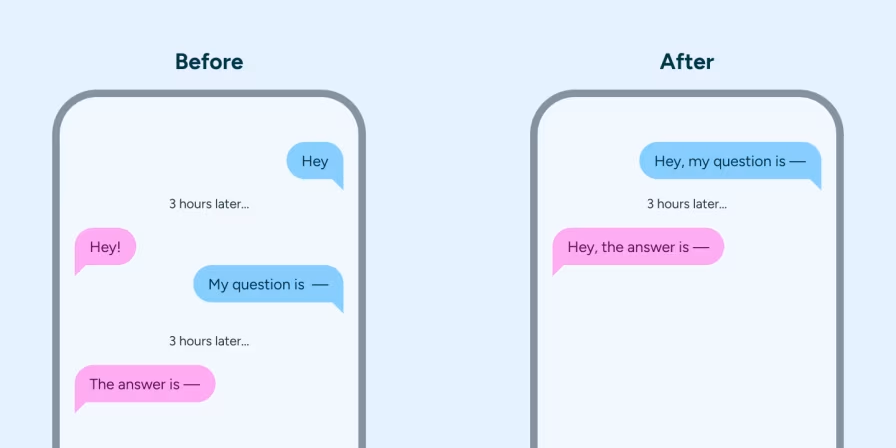
This is why I suggest adding as much context as you can in your initial message. Use async comms the way they're intended.
Bottom Line Up Front (BLUF)
BLUF
For longer messages, you should include your ask and any short but immediate context up at the top of the message and include context later.
While the phrase "Bottom Line Up Front" (or "BLUF") has origins in the U.S. military, the core principals can be highly useful in civilian contexts as well. The gist of it is simple: For longer messages, kickstart your conversation with your ultimate ask at the front of the conversation.
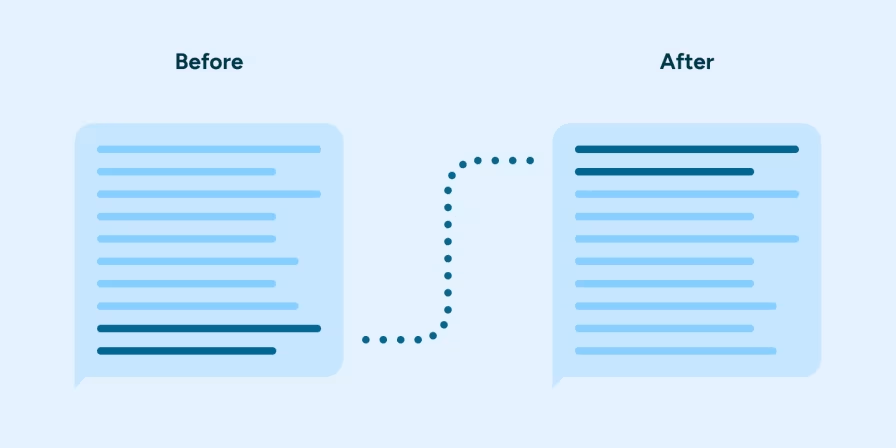
This is helpful for all kinds of folks, but doubly so for those that are in high positions or are otherwise very busy. This allows the reader to reduce the amount of noise they need to ingest to make a decision and dictate where they can refocus that energy in further communications with you.
Focus on Formatting
One trick that many sites — including this one — use to get you focused for longer is by breaking up big blocks of text with different formatting?
Things like:
- Lists
- Tables
- Em Dashes
- Bolded text
- Italicized text
All work to make your content more glanceable. The more glanceable your content is, the more likely one is to stay on task with reading it all the way through.
The same hypothesis carries into messages. If you think a few keywords are important to gather intention, bold them! Want to ask a list of questions but need answers to a specific few?
- Number them
- Include the numbers in follow-ups
That way, when someone says "About #1", you both know what you're talking about.
Takeaway
Learn to add visual flair in your messages.
Engineering Your Team's Comms
Simply structuring your messages won't solve issues in your teams' communication pipeline, however. Let's take a look at a few things that can be done to improve communications at a more systemic scale.
Sync vs. Async
We've all heard it before: "This could have been an email."
And you know what? Most of the time, that meeting probably could have been one, too. Not only do long-toothed meetings take up time, but in an organization time is literally money (through hefty engineering salaries and the sorts). Consider the following:
| Item | Value |
|---|---|
| Attendees | 5 |
| Average Salary | $80,000 |
| Duration (mins) | 60 |
| Per-meeting cost | $192.31 |
| Yearly cost (if weekly) | $10,000 |
And that's for a weekly meeting! When I first joined my company as VP, I was mortified to find that many of our team members were all joining a daily org-wide call that lasted upwards of an hour and half; you can imagine the cost that must've incurred over time!
If you must have a synchronous call, you should broadly make sure that it:
- Has a clear agenda
- Requires all the attendees to be there
- Has some level of time-sensitivity to it
Grading Rubric
There's a handy grading rubric and cost calculator for your meetings available at "thismeetingcouldhavebeenanemail.org". I don't know who made it, but it's glorious!
Synthesizing Summaries
You start a thread right before lunch, a challenging topic has come up in your work, and you're looking for an answer. You make sure you include all the right context, formatting, and the other goodies we've talked about. You leave for lunch. When you return:

Oh, dear. It seems like your team has a lot to say on the topic. But you've been out! Are you to read all 59 messages to catch up? What about the next person who wonders in?
How to solve this
Add a summary to long-running threads.
Summaries are incredible ways of getting multiple ideas documented at once — retaining the context and nuance of it all — while removing much of the unnecessary chitter chatter.
You can do this in a number of ways:
- Add a summary to the top message of a thread — pinning it if your app allows you to.
- Move off chat apps and into an RFC document, where you can comment and edit specific points and make multiple proposals.
The second works particularly well if this decision you're debating has long-standing consequences. Having a point of reference for future folks is very advantageous in team comms.
Default to Documentable Communication
When working with teams, it's common to get direct messages asking questions about a particular piece of technology or some other decision-making that needs to occur.
This seems innocuous enough and almost certainly doesn't come with any malice but can be problematic for a few reasons:
- It insulates the information to a select few, making it harder to share this information with others if needed down the line.
- Others who might be knowledgeable on the topic are not able to join into the conversation.
- It inhibits the knowledge being ascertained from transferring to bystanders, who might not think to ask the question otherwise.
It's not isolated to messages, either. Asking to jump into a 1:1 call for a pair programming session, while helpful at times, means that others can't jump in and participate or learn from the experiences. Likewise, business or broader technical decisions made in those calls are often lost or need to be reevaluated with fresh eyes at some point.
To solve these problems, I often suggest that communication be made public by default. This means that all questions that are not explicitly more appropriate for private comms be made into messages or otherwise written forms of communication that are indexed and able to be found trivially.
This includes async calls, too; either hold them in a space where people can freely join if they'd like, take notes or use AI transcription to publish the recordings, or both!
Team Size Shyness
This problem of defaulting to private comms is exacerbated when you only have larger group chats available to raise questions in; since many feel uncomfortable with feeling foolish or stupid.
To help mitigate this, create smaller environments that are still publicly viewable (and maybe even able to message in), but don't inherently advertise the group outside of those that need to be there.
This is also partly a sign of broader cultural change that might need to occur to help others (especially juniors) find their voices. Reward speaking publicly when it otherwise might feel silly, don't punish "dumb" questions, and encourage regular active Q&A sessions.
Leadership Through Communication
The people on your teams are, first and foremost, people. It can be tricky to context switch between engineering work and soft skills at times. To help along that path, here are a few things that I like to keep in mind when chatting with my peers.
Seek to Understand First
When working with a new team (or team member), there's a strong temptation to leverage existing knowledge and experience to asset positive changes in favor of forward momentum.
Before you do, however, I implore you: Ask as many questions as you can before suggesting things yourself.
By asking questions first, you're able to understand pain points in a system. Often, someone may have tried what's intuitive to you before, and it hit roadblocks for one reason or another. By being inquisitive, you're able to avoid many headaches by reintroducing old ideas once again.
Ask, ask, ask again
Even if a question feels silly to ask, you can often glean a lot of information through this process. If you're feeling uncomfortable asking too many questions, start by finding where previous decisions have been documented. If you find that there are little docs for what you're wanting to know, maybe start by producing those historically relevant documents first!
Even if you're a subject-matter expert on the topic in question, having the "ask first" mentality is a strong tool to have in one's toolbox. I've seen this play out to be immensely helpful in two different circumstances in particular:
-
When the other party is willing to learn but doesn't know the right questions to ask yet.
In this example, the other party can explain their baseline to you through the right inquiries. This established baseline can then be used as a reference point for you to jump in and educate with a better understanding of their limitations and existing convictions.
-
When the other party is unwilling to learn and believes they know better than you do.
In circumstances like these, asking questions helps you break through to the misunderstandings the other party might have. In some instances, they might be right; they happen to have spent time in a given area long enough to be sharper on a topic than you are. In other instances, you might find that you're more informed on the topic, but the unwillingness to learn has stemmed from a misconception (or similar) on their end.
Regardless, by asking questions first, you're able to figure out where the other party aligns and help bring them towards your objectives.
Systemically Adding Rationale
I don't know about you, but when I was younger, I used to loathe the response of "because I told you to" whenever there was an open-ended question about my parent's decision-making.
What would usually start with genuine inquisitiveness would be shut down by a lack of willingness to explain one's thought process. This typically led to stubbornness and uncooperativeness on the child's end; feeling ignored and untaught.
Now, as an adult and professional, I often see many managers making the same mistake. Maybe not so brazenly, but many in management don't follow up their engineering asks with rationale for how that decision was made.
In both instances, you're removing the other party from being able to understand the problem that you're aiming to solve in any deeper capacity. Even when this doesn't breed dissent, it means that you can only be so invested into the solution. And even when you find a reportee who's consistently engaged, they may not be able to ask questions that you may have missed during the discovery phase.
Outline your reasonings
Instead of assigning tickets without context, try to include the original ask and how you came to the conclusion of what you're asking to build. Even better, include some of your engineering staff in meetings that pertain to product planning. Having them in the room can consistently bring up good edge-cases you may not have thought of otherwise.
Practice Active Listening
When I schedule 1 on 1s with my team, it can be tempting to schedule that time over other things I have going on. Maybe I'm driving back home from lunch and believe that I can pay attention to the conversation while maneuvering quiet roads.
I urge you, however, to avoid this temptation. Instead, give important meetings (especially one-on-ones) your utmost attention by:
- Not doing other things during your meetings.
- Having your camera on, even when you might otherwise have it off.
- Using open-ended questions to gather more information.
- Acknowledging emotions that are brought up during calls.
- Paraphrasing what you've been told to ensure that you're on the right track.
Remember, if you're leading a team, those team members are often looking to you for not only technical guidance but . By forcing yourself to be maximally attentive, you're reassuring that you're on their side and willing and able to help out.
And paraphrasing might sound silly, but it helps! Not only does this form of active listening help the other party feel like they're being heard, but it can help lead to clarify mistakes in comprehension. I've had a number of instances where I misheard what was being said, and summarizing what they said was able to help me catch mistakes in my comprehension.
A reminder for yourself
If you're having difficulties focusing on a conversation or realize that you'll be otherwise preoccupied during regularly scheduled calls, it's alright to reschedule! Rescheduling feels bad when you want to be present for the other party, but if it helps you be more aligned with the other party, it will have been worth it.
Build, Don't Block
There's a certain kind of engineer that can be difficult to work around: They're excited to jump a number of steps ahead of where you believe you and your team can tackle. Maybe they're planning for the scale of millions of users when you have a couple of thousand.
"Why is that kind of engineer challenging to work with? They usually bring good ideas to the table even if they're not given at the right time."
Exactly; it's about that timing challenge. For many managers it's difficult to put their colleagues' ideas off to the side while retaining that developer's excitement.
After all, it's not fun for anyone to be told "No" on a consistent basis. This is true even in instances where someone is generally given a fair amount of leeway and is regularly given the freedom to do what they believe in. It only takes one incident where excitement to work is met with negative tonality that can shift the mindset on one's work.
So, what's the solve? "Yes, and" them!
This doesn't mean that you agree with diverting effort immediately, but it means that you can play off of others' excitement, even when redirecting it.
"Yes! That's a great vision for where we need to be. And what's the one-day version of that we could build right now to prove the concept?"
Is a much more powerful sentiment to keep momentum than:
"That feels too far out of scope."
Praise in Public, Correct in Private
When you see behavior that's not up to your or your group's standards, you may want to call it out in the spot; regardless of if you're in a group environment or not. While this may be appropriate in some extreme instances, it's broadly better guidance to follow the rule of "praise in public, correct in private."
For example, let's say that you're in standup and someone brings up a pull request that you think has exceeded scope. The natural inclination might be to make a comment about how they can break up that work, doing so can lead to a damaged working relationship.
After all, it's not a great time when you feel embarrassed in front of others. And I don't know about you, but I'm more likely to lash out and become defensive in group environments, even when I need to hear that feedback.
This doesn't mean that you can't share negatives of another team member upwards to higher levels of management, however. If you feel the need to comment on something, it might behoove you to acknowledge this feeling with those above you for transparency's sake. Especially if they report to you, having this documentation can be important if you need to justify corrective action in the future.
Important distinction
The above doesn't mean that you need to raise every minor incident that occurs. The key difference is patterns vs. incidents. A single minor-incident (e.g., someone is terse in one message) is often best ignored. A pattern of small incidents (e.g., that person is terse in every message) is a problem that needs to be addressed, as it impacts the team. Raise patterns, not isolated incidents.
On the flip side, though, if you're proud of someone's work — let the world know it! It's a great feeling to share that pride with the rest of your team, and especially with management above yourself. Our work as engineering leadership is broad meant to spread the good on a team, not to hog the praise ourselves.
Conclusion
Building out your communication skills isn't just a single skill you can point to directly; it's a series of stepping stones that build on top of one another to form a rock-solid foundation for effective team skills.
It starts with mastering your own messages; structuring them through clear, direct, and respectful communications that let your fellow engineers know that you value them and their time.
Next, you graduate to helping engineer your team's environment, building systems that encourage clarity and documentation.
Finally, you use communication to lead your team; building out trust, providing rationales, and guiding things with empathy.
Those that learn to master all three don't just solve technical problems; they become the leaders who guide their organizations.
What are your favorite engineering communication tips? Let us know in our Discord and kickstart a new conversation on good team comms!